
At a glance
Army University is hiring a vice provost for institutional effectiveness to fold its component colleges into one accreditation, with a 2027 self-study and new federal rules looming.
One line in the announcement does most of the work. The Vice Provost for Institutional Effectiveness at the U.S. Army War College will "cohere existing disparate accreditations of component colleges and programs into a unified University accreditation" — which is a merger, conducted in paperwork, of the Army's professional military education system. Applications close at 11:59 p.m. Eastern on 1 December 2026 through the federal posting, and the salary runs from $139,568 to $167,829 for the Carlisle Barracks, Pennsylvania duty station.
The same announcement can be filled at Fort Leavenworth, Kansas, where the listed range opens slightly lower at $139,031 and closes at the same $167,829. Applicants state a location preference in the questionnaire rather than being assigned one. And the position, as the description puts it, "currently resides in the U.S. Army War College but will transition to Army University" — a sentence that says plenty about where the institution believes its future sits.
Army University was chartered in 2015 to bring the Army's schools, colleges and academies under one academic roof, with a provost, a governing board and a curriculum development center. A decade later the roof exists. What doesn't exist is a single accreditation covering everything beneath it. Component colleges carry their own recognition from bodies including the Middle States Commission on Higher Education and the Higher Learning Commission, while officer education answers to a separate authority entirely: the Joint Staff.
The Two Rulebooks This Seat Has to Serve
The posting asks for familiarity with the Middle States Commission on Higher Education and the Higher Learning Commission. It also asks for familiarity with the Officer Professional Military Education Policy, CJCSI 1800.01G, a Chairman of the Joint Chiefs instruction that prescribes what officers must be taught before they are certified as joint-qualified. Two civilian accreditors and one military instruction, all governing the same classrooms.
They do not ask the same questions. A civilian accreditor wants to see an organized, sustained assessment process with faculty leading the review of student learning, and evidence that the results changed something. The Joint Staff wants proof that the curriculum delivers the prescribed joint learning areas. One rewards a faculty that owns the loop and revises courses when the evidence says to. The other measures fidelity to a national standard written in the Pentagon.
That tension is not theoretical at Carlisle. In March 2015 the Middle States Commission told the college, in writing, that a monitoring report due 1 April 2016 had to document "further implementation of an organized and sustained assessment process, with evidence of (1) faculty leadership in the assessment of student learning and (2) appropriate assessments of the attainment of student learning goals." A war college can meet every joint standard and still fail that test, because the test is about who owns the evidence, not whether the syllabus is correct.
What the Commission's File Already Shows
The War College has held Middle States accreditation since June 2004, was reaffirmed most recently in March 2019, and is scheduled for its next self-study evaluation in 2027–2028. Its approved scope covers a master's degree or equivalent and a post-baccalaureate certificate. Distance education is approved as a delivery method; correspondence education is not. The full statement of accreditation status is public on the commission's institution page.
Read the action history closely and a pattern appears that the incoming vice provost will recognize immediately. Since 2022 the commission has asked the college for supplemental information reports on enrollment three times — in December 2022 on enrollment by educational program, in November 2023 and again in January 2025 on full-time-equivalent enrollment drawn from the annual institutional update. The January 2025 request carried a February 14 due date and was acknowledged by staff on 6 June 2025.
None of this is a sanction. The requests flow from a federal monitoring rule, 34 CFR 602.19, that requires accreditors to watch key data indicators, and enrollment is on the list. But routine obligations become somebody's Tuesday afternoon, and at a college whose student body is assigned by Army personnel systems rather than recruited by admissions, a falling FTE number has no marketing fix. The only available response is an explanation, and explanations require a data office that can produce them on demand.
A Command Moved Out From Under the Post
Whoever fills this role will also inherit a reorganised chain of command. A Department of the Army directive effective 1 October 2025 established the U.S. Army Transformation and Training Command by consolidating Training and Doctrine Command with Army Futures Command, redesignated the Combined Arms Center as the Combined Arms Command, and reassigned the Army War College to the Combined Arms Command as a subordinate element. The directive spells out the new reporting lines in a single page of numbered paragraphs.
TRADOC's colors were cased at Fort Eustis on 26 September 2025 after 52 years; the new command activated on 2 October in Austin, Texas, under Gen. David Hodne. At the activation, Chief of Staff Gen. Randy George described the change as a way to "ensure that training and education remain modern and world-class," naming Army University among the institutions that would feel the effect. The Association of the U.S. Army's account of the ceremony captures the intent: fewer headquarters, consolidated authorities, one command responsible for force design and force generation together.
For an accreditation office, consolidation cuts both ways. It shortens the distance between the person writing the self-study and the person who controls the budget for assessment staff. It also puts the War College one level further from the top of the chain than it sat as a direct reporting unit to the Chief of Staff — and the posting itself still lists "U.S. Army Training and Transformation Command" among the bodies whose accreditation the role monitors, a name that hasn't quite settled into the form the directive uses.
One detail ties the whole arrangement together. Army University's provost is Dr. David Dworak. The Middle States Commission lists the War College's accreditation liaison officer as Dr. David Dworak. The same person holds the institutional accreditation relationship and the university-wide academic portfolio, which is either the cleanest possible arrangement or the clearest sign that the office is being run out of one desk until the new hire arrives.
Washington Is Rewriting the Rulebook in the Same Cycle
The standards this position must satisfy are themselves in motion. On 22 January 2026 the Department of Education announced a negotiated rulemaking committee on accreditation, innovation and modernisation; the panel met in April and May 2026 and reached consensus on a package the department then published substantially as negotiated. Among its provisions: removal of geographic scope for accreditors, easier institutional switching, elimination of the two-year operating requirement for new accreditors, and a shift toward judging accreditors on student outcomes, faculty evaluation and academic freedom protections. The earliest possible effective date is 1 July 2027.
Separately, in February 2026 the department issued a proposed interpretive rule directing accreditors to stop describing themselves as regional, on the grounds that the label misleads students and distorts credit transfer. Middle States now describes itself as a global institutional accreditor. The department's announcement is blunt about the reasoning.
Line up the calendars and the risk is obvious. The War College's self-study evaluation falls in 2027–2028. The new federal framework could take effect in July 2027. Whoever takes this job may write a self-study against standards that are amended while the document is in draft — and may have to defend, to a commission adjusting to new criteria, evidence gathered under the old ones.
Who Benefits, and Who Absorbs the Extra Work
The case for unification is easiest to make from a soldier's side of the desk. Army University's own published rationale for its accreditation and credentialing work is that clearer recognition of military learning produces academic credit and professional credentials that travel into civilian life. A single institutional accreditation is what makes a transcript from one component college mean the same thing as a transcript from another, rather than depending on which school a sergeant happened to attend.
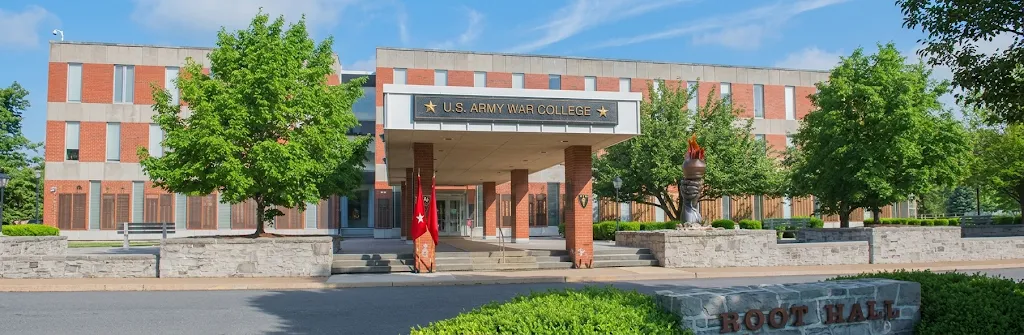
The distance program sharpens the point. Roughly 800 students are enrolled at the War College at any one time, split between a ten-month resident course and a two-year distance program, and the commission has approved distance education within the accredited scope. Those students never set foot in Root Hall. If the value of the credential depends on where it was earned, they are the ones exposed.
The cost lands elsewhere. Consolidating accreditation moves work from component colleges to a central office, and central offices write templates. A school with a handful of faculty and no institutional research staff will fill in whatever template it is handed, on top of teaching, and the quality of what it returns will depend on whether anyone at the center spent time building its capacity. That is the quiet equity problem in every accreditation merger: the reporting requirement is universal, the staffing to meet it is not, and the gap shows up in the findings.
The Application Screens Harder Than the Title Suggests
This is a Title 10 civilian faculty appointment in the excepted service, initially up to three years, renewable in one- to five-year increments. It comes with a trial period of one or two years, a background investigation, eligibility for a SECRET clearance, and travel away from duty about 10 percent of the time. The minimum qualification is a bachelor's degree in a behavioural or social science or equivalent experience; a PhD or other terminal degree in higher education administration, education policy, research methodology, organisational leadership or institutional research is preferred.
The paperwork is where casual applicants fall out. The resume must be two pages or less, and longer ones are removed from consideration before anyone reads them. A letter of application must address each knowledge, skill and ability statement directly. Unofficial transcripts go in with the application; official ones follow if you are selected. Four professional references are required, and they must be disinterested — people who can speak to your qualifications and have no stake in the outcome. In a field as small as institutional research, where most senior people have worked with or for one another, that is a stricter bar than it reads.
| Item | Detail |
|---|---|
| Announcement | USAJOBS vacancy 891032200, open to U.S. citizens |
| Closing | 1 December 2026, 11:59 p.m. Eastern |
| Duty station | Carlisle Barracks, Pennsylvania or Fort Leavenworth, Kansas; preference stated in the questionnaire |
| Salary | $139,568 to $167,829 (Carlisle Barracks); $139,031 to $167,829 (Fort Leavenworth) |
| Term | Up to three years initially, renewable in one- to five-year increments |
| Contact | Dr. Doug Winton, Deputy Provost, Army University |
The duties run wider than the title. Beyond assessment policy and the annual assessment strategy, the role sets policy for the Army War College and Army University Human Research Protection Program, counsels faculty on institutional improvement and research protection, produces reports that feed into Army, Joint Force and Department of War education policy, advises the Academic and Research Board, and may serve as designated federal official for the Army Education Advisory Committee and its semiannual meetings. Teaching, research and service are part of the appointment, as they are for any faculty member. Full details and the application portal are on USAJOBS.
The Question Waiting in Year Two
Three clocks are running at once. A self-study cycle scheduled for 2027–2028. A command that activated in October 2025 and is still deciding what its subordinate schools owe it. A federal accreditation framework that could take effect in July 2027 with different tests than the ones currently in force. The person hired will spend the first year building a plan that satisfies all three, and will sound credible doing it, because the plan is the easy part.
Year two is harder. That is when the annual assessment strategy reaches a school whose entire faculty is on orders, whose students rotate out every ten months, and where the person who was supposed to compile the evidence has been reassigned. The question implementers will face then is not whether the assessment framework was written well. It is whether the university funded the capacity to feed it — at every component, not just the ones with a project manager — and whether a unified accreditation turns out to mean one standard for everybody, or one office doing the reporting while the smallest schools absorb the consequences of the numbers they can't explain.
- higher-education-leadership
- accreditation
- institutional-research
- u.s.-army-war-college
- army-university