

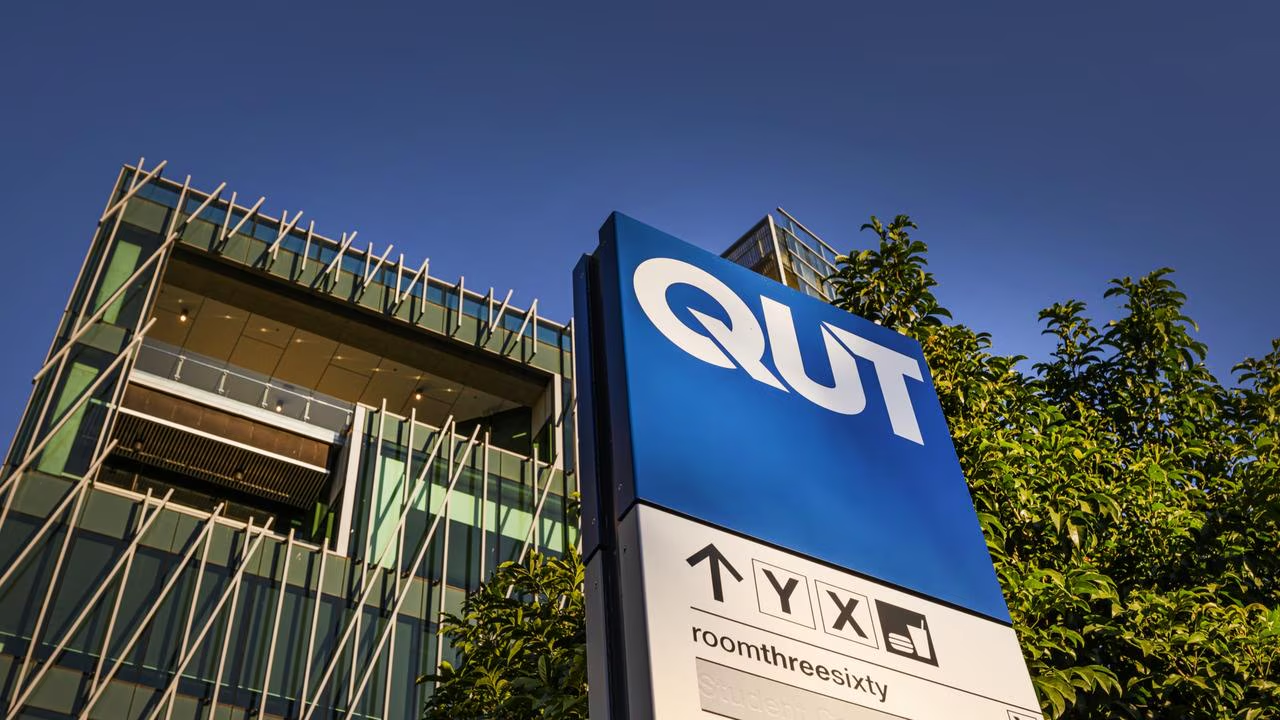
Queensland University of Technology has opened applications for a Facilities and Infrastructure Technologist, a role that rarely makes front-page announcements but decides whether research keeps moving or stops for weeks. QUT is a two-campus university in Brisbane with more than 50,000 students and a research footprint spread across laboratories, engineering workshops, biomedical spaces, and imaging suites. The person hired for this role will operate at the edge between those physical systems and the researchers who rely on them.
A colleague at a Brisbane materials laboratory — call her Dr T — watched a six-week experiment fail because a single fume hood alarm had been silenced and then ignored. The technologist who would have caught it had left months earlier, and the post stayed empty while three separate projects queued behind the failure. That gap is the problem QUT's advertisement is designed to close. The job title sounds administrative, but the actual hire sits on the front line of research infrastructure.
The daily work behind the title
The position description matters more than the job title. In Australian universities, a facilities and infrastructure technologist generally splits time among technical operation, facilities coordination, capital planning, and the unglamorous work of emergency response. Technical operation means calibrating instruments, fault-finding, managing chemical and biological storage, and helping researchers who are not equipment specialists. Facilities coordination means working with estates staff on power supply, ventilation, gas lines, and building management alarms. Capital planning means advising on laboratory refurbishments, new equipment purchases, and layouts that prevent contamination or vibration problems.
At QUT, that work is likely to span Gardens Point in the Brisbane city centre, where space is tight and building services are shared, and Kelvin Grove, where health, education, and creative industries facilities bring different safety and infrastructure demands. A technologist who can read a building management system log and a mass spectrometer manual with equal comfort fits the profile better than a single-instrument specialist.
Applicants should already know that Australian Standard AS 2243 sets the baseline for laboratory safety, covering fume cupboard operation, emergency showers, and handling of hazardous substances. Experience with AS/NZS 3000, the Australian wiring rules, matters when laboratory power distribution is part of the job. None of this shows up in a press release, but it is what a good hire uses on the first afternoon.
Why the hire speaks to a national problem
Australia's research system depends on technical staff, yet those staff are among the least visible parts of the workforce. The 2021 National Research Infrastructure Roadmap described shortages of skilled technical and professional staff as a persistent risk to Australian science. The people who keep instruments alive are often older and nearing retirement, and replacements are not being trained at the same rate. One advertised role at QUT will not solve that by itself, but it is a useful signal that a university is putting a named position behind the problem.
I have seen the base rate play out inside a single department. For every smooth equipment booking, there is a laboratory manager who has not taken leave in two years because no one else can run an autoclave validation. When the senior technologist retires, thirty years of undocumented knowledge about a particular nuclear magnetic resonance instrument leaves with them. QUT's hire is, in practical terms, an attempt to capture that knowledge and make it institutional before it walks out the door.
Where the role fits in the national and university machinery
The Commonwealth's National Collaborative Research Infrastructure Strategy funds national facilities across areas from advanced manufacturing to biomedical imaging. The same principle applies inside a university: funded infrastructure only produces results if someone is accountable for its day-to-day condition. QUT's research and innovation pages describe platforms used by external industry partners as well as internal students, and every one of those platforms depends on technical staff.
The QUT application portal lists the position alongside dozens of other professional vacancies, but this one sits in the research support stream rather than a traditional IT or estates team. Prospective applicants should treat the listed contact officer as the most reliable source of detail about which facilities are in scope. That detail will shape an application more than a generic CV will.
For someone coming from industry, the university environment has a particular rhythm: workloads peak around grant milestones, equipment downtime is measured in months rather than weeks when procurement is involved, and safety compliance is not negotiable. The right candidate can describe a time they kept a critical piece of infrastructure running under a budget constraint, not just a time they followed a manual.
How to apply without burying the point
QUT uses an online recruitment portal, and the application form follows the standard sector pattern: a CV, a cover letter, and responses to selection criteria. The criteria for a technical role usually ask for demonstrated experience maintaining specific instrument types, managing laboratory spaces, and applying work health and safety requirements. The weakest application I have reviewed in a similar process began with a list of personality adjectives and never named a single instrument. Don't do that.
- Name the instruments and facilities you have actually run, with enough context to show you understand their failure modes.
- Quantify downtime and throughput where you can: a reduction in instrument downtime from 14 days to 4 days is concrete.
- Describe your role in laboratory safety audits and incident responses, not just attendance at training.
- Mention brownfield laboratory retrofit experience if you have it, because universities rarely get new builds; they renovate old ones while research continues.
If you are coming to this role from a research assistant background in Australia, there is useful context in AcademicJobs' own guide on how to excel as a research assistant in Australia. The equipment-specific habits it describes transfer directly to a technologist path, especially the parts about record keeping and taking ownership of shared instruments.
What this means for your lab
The QUT advertisement is one data point in a broader push among Australian universities to treat technical roles as core research infrastructure rather than support overhead. For a laboratory manager reading this, the implication is straightforward: the next time a key instrument goes down, record the downtime in hours, not days. That number is the business case for your next technical hire.
If you are an early-career researcher weighing a technical career against a traditional academic one, roles like this offer a clearer metric of impact. You will not get a named chair, but you will know whether the building is still running at 4 pm. Universities that understand that trade-off tend to retain good people.
Start with the piece of infrastructure your lab cannot afford to lose for a week. Find its service history, its single point of failure, and the named owner. That document is a draft job application for someone like this, and it is also the first page of a better lab.

.jpg)


Discussion
Be the first to comment on this article!
You’ll be asked to sign in before your comment is posted.