 Academic Connect
Part-time Faculty, Computation, Technology & Culture
Job Details
Posting Details
Position Information
Title: Part-time Faculty, Computation, Technology & CultureDepartment: Division of Experimental + Foundation Studies
Division: Experimental + Found Studies
Employment Type: Part-Time
Critical Review Track (similar to tenure track): No
Position Description
The Division of Experimental and Foundation Studies, Rhode Island School of Design (RISD) invites applications for Part Time Faculty faculty to teach in Computation, Technology & Culture with appointments to begin in fall 2026.
RISD recognizes principles of social equity, inclusion, and diversity as fundamental to its mission as an art and design school. These principles require sustained attention to a multiplicity of differences and call for an expansion of the forms of knowledge that shape our curricula and pedagogy. RISD is committed to the collective work of institutional transformation and values applicants whose teaching, pedagogical and professional experiences have prepared them to foster and sustain equitable learning environments. We especially welcome faculty whose pedagogy engages diverse perspectives, expands forms of knowledge, and helps foster a culture of belonging where all students, staff, and faculty can thrive.
RISD’s Computation, Technology & Culture (CTC) Department is looking for part-time faculty as we expand our curriculum. CTC is RISD’s newest department, home to the Art and Computation BFA, the Sound BFA, and the CTC Concentration. We’re seeking artists, designers, and technologists who are excited to explore how digital and technological systems shape art and design—and how artists and designers can shape those systems in return.
As RISD’s newest department, Computation, Technology & Culture (CTC) brings together the Art and Computation BFA, the Sound BFA, and the CTC Concentration, serving students from across the college. While all CTC faculty are part of a single department, this search focuses on hiring adjunct faculty to teach within the Art and Computation area.
We are seeking artists, designers, and technologists whose creative and teaching practices engage critically and imaginatively with computation, technology, and culture. While CTC includes both the Art and Computation and Sound BFA programs, this search focuses on hiring faculty to teach within the Art and Computation area.
Teaching opportunities may include required Art and Computation courses such as Introduction to Computation, Introduction to Physical Computation, Materializing Code, Human–Machine Interactions, Seminar: Histories and Futures of Computational Art & Design, and Seminar: Critical Issues on Technology, as well as related elective courses that extend or expand the department’s focus areas.
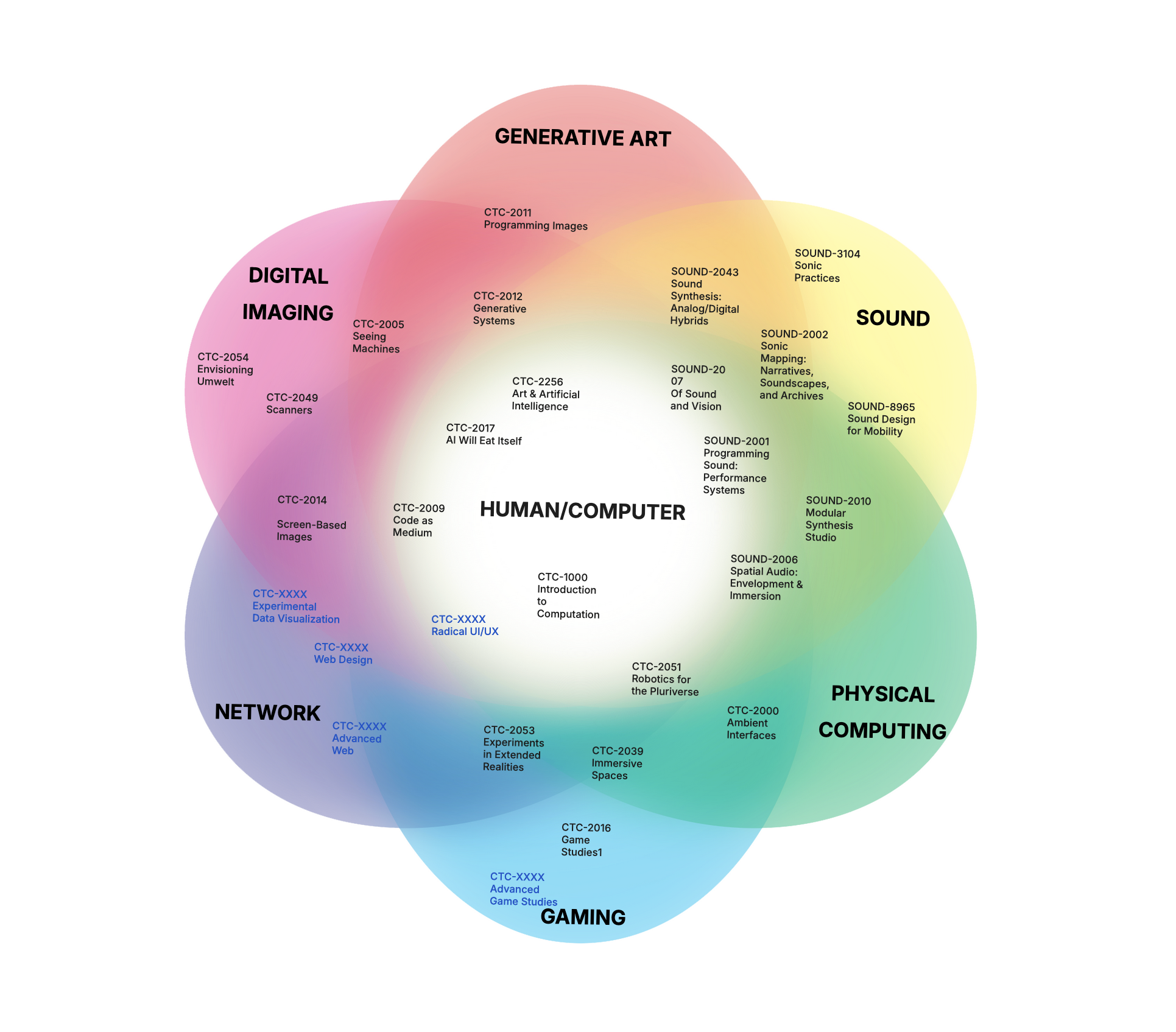
We are also seeking faculty who can teach electives that extend the department’s current focus areas or propose new electives that chart emerging directions in computational and technological art. Current focus areas include Human Computer Interaction, Networks and Web Art, Generative and AI Art, Physical Computing and Robotics, Digital and Computational Imaging, World-Building and Gaming. These focus areas represent evolving intersections between art, design, and technology, and we welcome proposals for electives that chart emerging directions or bridge multiple areas.
Qualified applicants may also be considered for shared Core Studios (Core 1, Core 2, Core 3, etc.), which serve both Art and Computation and Sound majors. These studios emphasize computational thinking, experimental making, and collaboration across disciplines, forming the connective tissue of the department’s curriculum.
Program Structure and Focus Areas
The Art and Computation BFA and Sound BFA share a six-semester Core Studio sequence that forms the foundation of the department. The Core guides students from directed assignments and structured learning to self-directed, collaborative, and large-scale projects in their final years.
Alongside the Core, Art and Computation students take a series of six departmental courses:
- Introduction to Computation
- Introduction to Physical Computation
- Materializing Code
- Human–Machine Interactions
- Seminar: Histories and Futures of Computational Art & Design
- Seminar: Critical Issues on Technology
Students also select from six departmental electives, which allow them to deepen their practice in specific technical and conceptual areas. These electives align with and expand the department’s focus areas, which represent evolving intersections between art, design, and technology shared by both Art and Computation and Sound majors:
- Human Computer Interaction
- Networks and Web Art
- Generative and AI Art
- Physical Computing and Robotics
- Computational and Digital Imaging
- World-Building and Gaming
Together, the Core, seminars, and electives form a coherent structure that supports experimentation, interdisciplinary dialogue, and critical engagement with technology as both medium and subject.
(For a visual overview of the program and its focus areas, see the Art and Computation Curriculum Map and the CTC Focus Areas diagram.)
Required Qualifications
- MFA or equivalent professional experience in art, design, computer science, or a related field
- College-level teaching experience in one or more of the following: creative coding, 3D modeling and world-building, web design, generative systems, or interactive media
- Demonstrated commitment to inclusive, culturally responsive, and accessible pedagogies that support equitable learning environments and effective engagement with diverse student populations.
- Active creative practice or research that connects technology and culture through art, design, or computation
Preferred Qualifications
- Experience teaching in interdisciplinary or experimental studio environments. Ability to teach and support students across multiple year levels and majors within a shared learning environment.
- Familiarity with creative coding and interactive media environments such as JavaScript, Python, p5.js, Processing, Unity, Unreal Engine, Blender, TouchDesigner, and Three.js, as well as imaging, vector, and video editing software (e.g., Photoshop, Illustrator, Premiere, or equivalent).
- Interest in collaborative or cross-departmental projects
RISD/ Department Description
RISD is a nonprofit college and museum of art and design founded in 1877 in the city of Providence, RI. Today 2,606 students from 62 countries engage in more than 40 full-time bachelor’s and master’s degree programs, supported by a committed faculty and worldwide network of more than 33,000 alumni.
By cultivating expansive and elastic thinking, RISD equips artists, designers and scholars to generate and challenge the ideas that shape our world.
The Department of Computation, Technology & Culture (CTC) explores how emerging technologies transform the ways we make, think, and live. CTC’s programs combine hands-on studio practice with critical and cultural inquiry, situating computation as both a material and conceptual medium. The department offers two undergraduate majors—Art and Computation (BFA) and Sound (BFA)—as well as a concentration available to students across RISD. Art and Computation majors develop fluency in computational technologies, writing code and creating projects across multiple programming languages while critically analyzing the cultural and societal impacts of technology. Sound majors engage in hands-on practice combining programming, immersive 3D spatial audio, composition, and performance, working with digital audio workstations, modular synthesizers, DIY electronics, and custom software. The CTC concentration provides students from any major the opportunity to integrate computational and technological literacy with their primary field of study. The department supports experimentation across digital and physical media, including code, sound, networks, sculpture, installation, and performance, preparing artists and designers to engage creatively and critically with technological systems.
Special Instructions to Applicants
Please attach the following to the appropriate links in the section labeled “Documents Needed to Apply”:
- Letter of intent indicating which course(s) you are most interested in teaching—Introduction to Computation, Introduction to Physical Computation, Materializing Code, and/or Human–Machine Interactions, Seminar: Histories and Futures of Computational Art & Design, Seminar: Critical Issues on Technology— as well as any general ideas for new electives in areas such as networks, digital imaging, gaming and world-building, physical computing and robotics, or generative art.
- Curriculum vitae
- A statement of teaching philosophy including how the candidate addresses diversity and inclusion as fundamental to a learning community
- Portfolio of recent professional work (20 images maximum, preferably in one PDF). Time-based media can be included as a link in the pdf.
- Examples of student work (20 images maximum, preferably in one PDF). Time-based media can be included as a link in the pdf.
Applications may not be edited once they are certified and submitted.
Only materials that have been requested will be considered.
Names and contact information for three references are requested as part of the application process at the finalist stage.
Review of applications begins immediately and continues until the position is filled.
EEO Statement
RISD is an Equal Opportunity Employer. Employment decisions are made without regard to race, color, religion, sex, age, national origin, disability, veteran status, sexual orientation, gender identity or expression, genetics, or any other protected characteristic as established by law.
Whoops! This job is not yet sponsored…
Or, view more options below
View full job details
See the complete job description, requirements, and application process
Express interest in this position
Let AcademicJobs.com know you're interested in Part-time Faculty, Computation, Technology & Culture
 Express Interest
Get similar job alerts
Receive notifications when similar positions become available






.jpg&w=128&q=75)